SAMBELTA, Innovative KKP Unismuh Makassar Transforms River Waste into a Local Specialty Product
BARU — What has long been considered a natural product for daily consumption has turned out to hold the potential to become a valuable food product.
This is what the students of the Muhammadiyah University (Unismuh) Makassar 06 Professional Work Program (KKP) are trying to prove in Lompo Tengah Village, Tanete Riaja Subdistrict, Barru Regency, South Sulawesi.
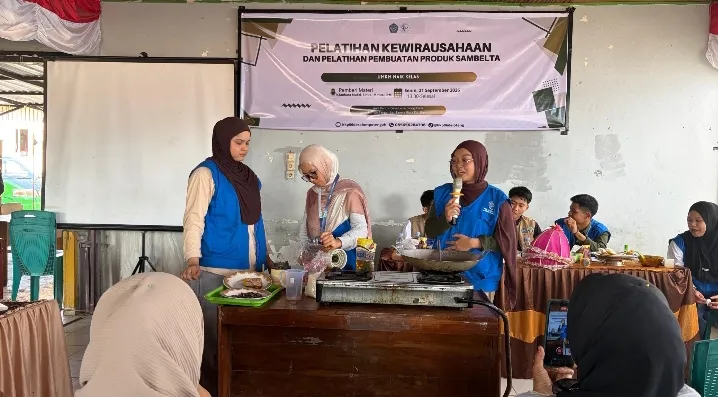
Through creativity and the utilization of local potential, the KKP 06 students process river clams, which can still be found in several rivers in Lompo Tengah Village, into a distinctive sambal product named SAMBELTA, an acronym for Lompo Tengah River Clam Sambal.
This innovation is not just about introducing a new processed food product. Behind SAMBELTA, the students are trying to see the potential that exists in the surrounding communities and transform it into a product that has added value and local identity.
From River Results to Village Identity
River clams have long been known and used by the community as one of the food ingredients for daily consumption.
However, the KKP 06 students believe that its use can be further developed.
Instead of letting this potential remain as a household consumption ingredient, the students try to present a more innovative form by making river clams the main ingredient in sambal.
This is where the idea of SAMBELTA was born.
The name was deliberately chosen to carry the Lompo Tengah identity, so that the product developed not only offers flavor, but also carries a story about the source of the ingredients and its origin.
With this approach, natural products that were previously simple have begun to be directed into products that have their own character and identity.
River Clams Processed, Local Flavors Presented
The process of making SAMBELTA starts with processing river clams obtained from the river.
The clam meat is then combined with various sambal ingredients to produce a product with a distinctive flavor.
The processing process is an important part of the 06 KKP student innovation. Because the development of village potential is not just about what is available in nature, but also how these resources can be processed into something that has higher utility and economic value.
The students then encourage this clam product to be more than just a trial product, but to have the opportunity to be packaged and introduced as a food product that carries the identity of Lompo Tengah Village.
When Village Potential Meets Student Creativity
The development of SAMBELTA shows that innovation in villages does not always have to start from something big.
Sometimes, the idea actually comes from something that has been around in the community for a long time.
River clams living in the rivers of Lompo Tengah Village are an example of how local resources can be seen from a different perspective. If before they were more often used for daily consumption, through the creativity of the 06 KKP students, river clams are now introduced in the form of processed products with wider development opportunities.
This approach is also an effort to introduce the potential of Lompo Tengah Village's local food.
The presence of river clams in several rivers is one of the natural resource potentials that can be developed into a product with a distinctive regional character.
SAMBELTA and the Hope of Opening Economic Opportunities
Through SAMBELTA, the 06 KKP students of Unismuh Makassar hope that the community can see river clams not only as a river product that is consumed for family needs, but also as a food ingredient that has the potential to be developed into a valuable economic product.
If developed sustainably, products based on local potential such as SAMBELTA can be part of the effort to introduce the richness of Lompo Tengah Village's food and open up space for community creativity in developing distinctive village products.
More than just sambal, SAMBELTA carries a simple message: village potential does not always have to be sought far and wide.
Sometimes, it is in the river that we pass every day, in the food ingredients that we have always considered ordinary, and in the hands of the community that then dares to process them into something different.
Through the creativity of the 06 KKP students, Lompo Tengah river clams are getting a new story—from river results to processed food, from daily consumption to added value, and from local potential to village identity.
This activity is related to SDGs, Specifically SDG 1 No Poverty through efforts to create business opportunities to produce products with economic value, SDG 8 Decent Work and Economic Growth through creating decent jobs to drive economic growth in the community, SDG 9 Industry, Innovation and Infrastructure through encouraging innovation in local products by utilizing local potential, SDG 12 Responsible Consumption and Production which is to manage resources wisely.
Sustainable Development Goals

Related News

Dorong Legalitas Usaha Lokal, Mahasiswa Unismuh Posko 08 Dampingi Kelompok Tani Gula Semut Desa Libureng Urus NIB

Pengajian dan Dialog Akademik, Rektor Unismuh Tekankan Pentingnya Sinergi dalam Mengemban Amanah

Jelang Semester Baru, Fakultas Pertanian Unismuh Gelar Dialog Akademik Perkuat Sinergi dan Kinerja Sivitas Akademika