UNIMUH Trains Fishermen Lette on Vaname Shrimp Cultivation with RAS System
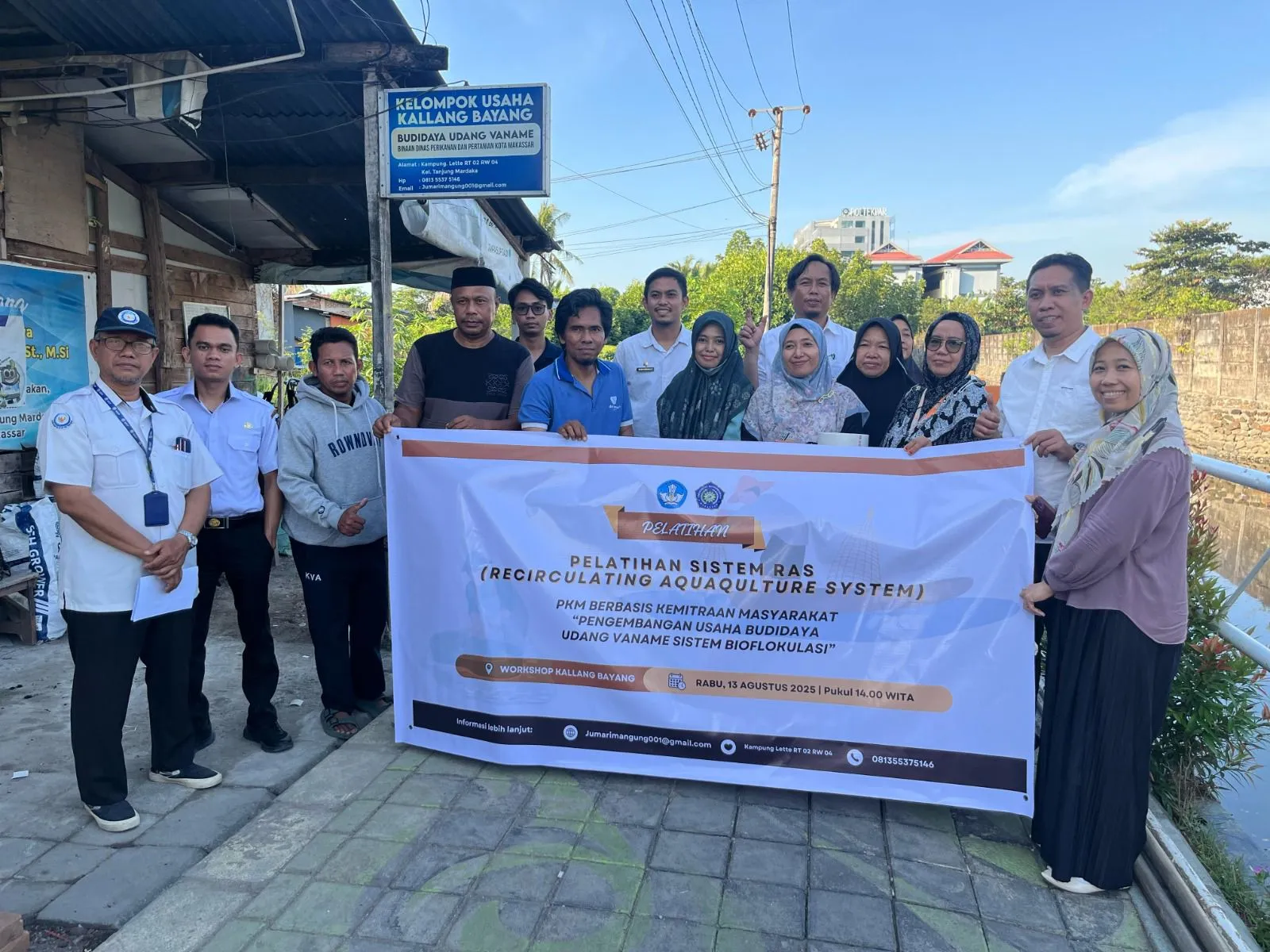
UNISMUH.AC.ID, MAKASSAR — The Unismuh Makassar University Service Team organized a training on vanname shrimp cultivation using the Recirculating Aquaculture System (RAS) at Kampung Nelayan Lette, Makassar, on Wednesday (August 13, 2025). The event was attended by the Kallang Bayang Fishermen Group, the Women's Farming Group, the Waste Bank Group, as well as representatives from the Makassar City Fisheries and Agriculture Department, including extension officers and aquaculture staff.
This training is part of the Community Partnership Service (PKM) program, funded by the Ministry of Education, Culture, Research, and Technology through LP3M Unismuh Makassar for the 2025 fiscal year. The program aims to achieve its vision, namely creating job opportunities, strengthening entrepreneurship, developing creative industries, and improving coastal fisheries infrastructure in Makassar.
The Chairman of the Kallang Bayang Fishermen Group, Jumari, explained that his group had previously been involved in vanname shrimp farming on a small scale. "We sell shrimp for small-scale fishing, from the Lakkang coast to Pulau Samalona. With this training, we want to develop our business from small-scale fishing to consumer shrimp cultivation," he said.
The training focuses on the application of the RAS technology, which allows for more efficient, environmentally friendly, and sustainable water management. The system uses three stages of filtration – chemical filtration with peat, biological filtration with zeolite, and mechanical filtration for solid particles – before the water is recirculated back to the tank using a circulation pump.
The Coordinator of Fisheries Extension officers believes that this training is important because it is the first time that fishermen have received such training. "We hope that Kampung Lette can become a learning laboratory for coastal fishermen," he said.
The Head of Tanjung Merdeka also expressed his appreciation. He said that his citizens, who generally do not have a background in fishing, need this kind of training to become independent and be able to support food security. "We are grateful to the university for being a partner. In the future, we hope there will be follow-up programs, such as urban farming and the development of fishermen's entrepreneurship, in line with the Makassar City Mayor's 'Tanami Tanahta' program," he said.
The Unismuh Makassar University Service Team, which involves academics from fields such as government, fisheries, architecture, and infrastructure design, has reaffirmed its commitment to improving food security and the welfare of coastal communities through sustainable technology and blue economy development.
Sustainable Development Goals


Related News
Unismuh Makassar Jajaki Kolaborasi BPDP Kembangkan Wirausaha Muda Perkebunan
13 Jul 2026
Prodi Agribisnis Unismuh Makassar Gelar Workshop Peninjauan Kurikulum Berbasis Outcome-Based Education
09 Jul 2026
Dosen Pertanian Unismuh Raih Doktor, Teliti Efisiensi Usahatani Kentang
30 Jun 2026